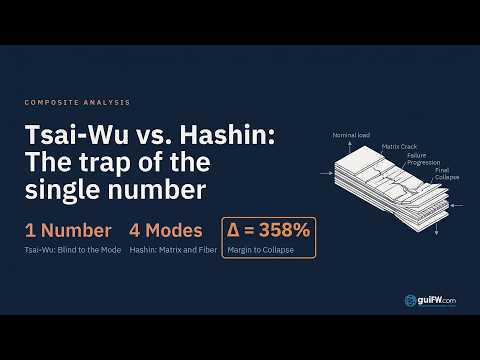
Tsai-Wu vs Hashin on composite tubes: the GFRP pole fails… but how?
The Tsai-Wu index tells you WHEN a part fails. It doesn't tell you HOW. In this technical training we apply the Tsai-Wu and Hashin failure criteria to a 12 m × 300 daN GFRP pole (a follow-up to the structural calculation video of the same pole) and show why, in filament-wound tubular structures, that difference changes the design decision.
What you'll see:
• How combined loads (bending, shear, axial and torsion) become σ1, σ2 and τ12 stresses in each layer (micromechanics + classical laminate theory)
• Why von Mises and Tresca give false confidence in composites (FS ≈ 8.6 vs an actual R ≈ 1.92)
• Tsai-Wu: one global, interactive index, easy to code — and its limitation
• Hashin (1980): four physical modes — fiber/matrix, tension/compression
• Ply and laminate failure envelopes, and a map of the index along the height and around the tube
• Progressive failure (ply discount) up to collapse, compared with local buckling
Case-study results (critical section 0.4 m above ground, nominal load):
• Tsai-Wu: R = 1.86 → FS/R index = 0.808 with FS = 1.5 (passes)
• Hashin: first failure = matrix tension cracking in the ±88° hoop layer, R = 1.92
• Fiber rupture (±15° layers): ≈ 9.3× the nominal load
• Local wall buckling: 6.13× · progressive collapse: 8.82×
The matrix warns you; the wall and the fiber decide.
Chapters
0:00 Intro: does the pole fail? How does it fail?
0:44 guiFW said 1.027. But what broke?
1:17 Combined loads at the pole base
1:50 From tube to ply: σ1, σ2, τ12
2:25 Why von Mises gives false confidence
2:55 The Tsai-Wu criterion
3:30 The Hashin criterion: four failure modes
3:58 Ply envelopes: one ellipse vs four boundaries
4:28 Case study: critical section, layer by layer
4:54 Where it fails: along the height and around the tube
5:16 Progressive failure: from first crack to collapse
5:48 The main lesson
6:09 Laminate envelopes in the σx–τxθ plane
6:35 Design decisions that delay the first crack
7:05 What about guiFW?
7:30 Designer's checklist
Code for this video (Python): micromechanics, CLT, loads, Tsai-Wu, Hashin, progressive failure, envelopes and charts — output to JSON, CSV and a calculation report.
References
• Tsai, S. W.; Wu, E. M. A general theory of strength for anisotropic materials. J. Composite Materials, 1971.
• Hashin, Z. Failure criteria for unidirectional fiber composites. J. Applied Mechanics, 1980.
• Strength tests: ASTM D3039, D6641, D3518, D2290.
Material and load values are examples. For a real design, use strengths measured on your own material and process.
guiFW — filament winding software and G-code: https://guifw.com
#composites #GFRP #TsaiWu #Hashin #filamentwinding #structuralengineering #FRP
Share:



Ajustes de tamanhos e limites
383 Views

Part 2 - Variable-thickness pole
409 Views

Part 1 - Setting up the environment
356 Views

Size and limit settings
358 Views



Parte 1 - Preparando el entorno
402 Views
Parte 2 - Poste de espesor variable
374 Views
Réglages de dimensions et limites
358 Views
Partie 2 - Poteau à épaisseur variable
355 Views

Partie 1 - Préparer l’environnement
413 Views

Größen und Grenzen einstellen
270 Views

Teil 1 - Umgebung einrichten
307 Views

Teil 2 - Mast mit variabler Wanddicke
417 Views

Regolazione di dimensioni e limiti
453 Views

Parte 2 - Palo a spessore variabile
335 Views

Parte 1 - Configurare l'ambiente
362 Views

Настройка размеров и пределов
277 Views

Часть 2 - Опора переменной толщины
286 Views

Часть 1 - Настройка среды
304 Views

Розміри та межі
314 Views

Частина 2 - Опора змінної товщини
293 Views

Частина 1 - Налаштування середовища
327 Views







आकार और लिमिट समायोजन
318 Views

भाग 2 - परिवर्ती मोटाई वाला पोल
370 Views

भाग 1 - एनवायरनमेंट तैयार करना
432 Views

ضبط الأبعاد والحدود
396 Views
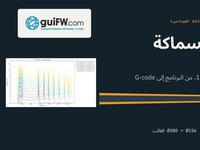
الجزء 2 - عمود بسماكة متغيرة
390 Views
الجزء 1 - إعداد البيئة
400 Views